Pranshi Mittal
· 11 min read
Want these checks mapped to your MSME onboarding flow? Request a 30-minute architecture review

Picture a credit officer with an MSME file open in front of her. The GST certificate is in the folder, the GSTIN is typed neatly on the application, and the number passes every format check. Is the registration still active? Does it belong to the person applying? Nothing in the file says.
That gap is where bad onboarding decisions start. A format is not proof. The five checks below close the gap in the order an NBFC would normally run them, and each one points to the FinHub API that supports it. All five can run at application stage, before anyone on your team spends time on the file.
India registers businesses for GST state by state, so one GSTIN rarely tells you the whole story about a borrower. That's why the checks go beyond the number on the form.
What Are the Five GST Checks?
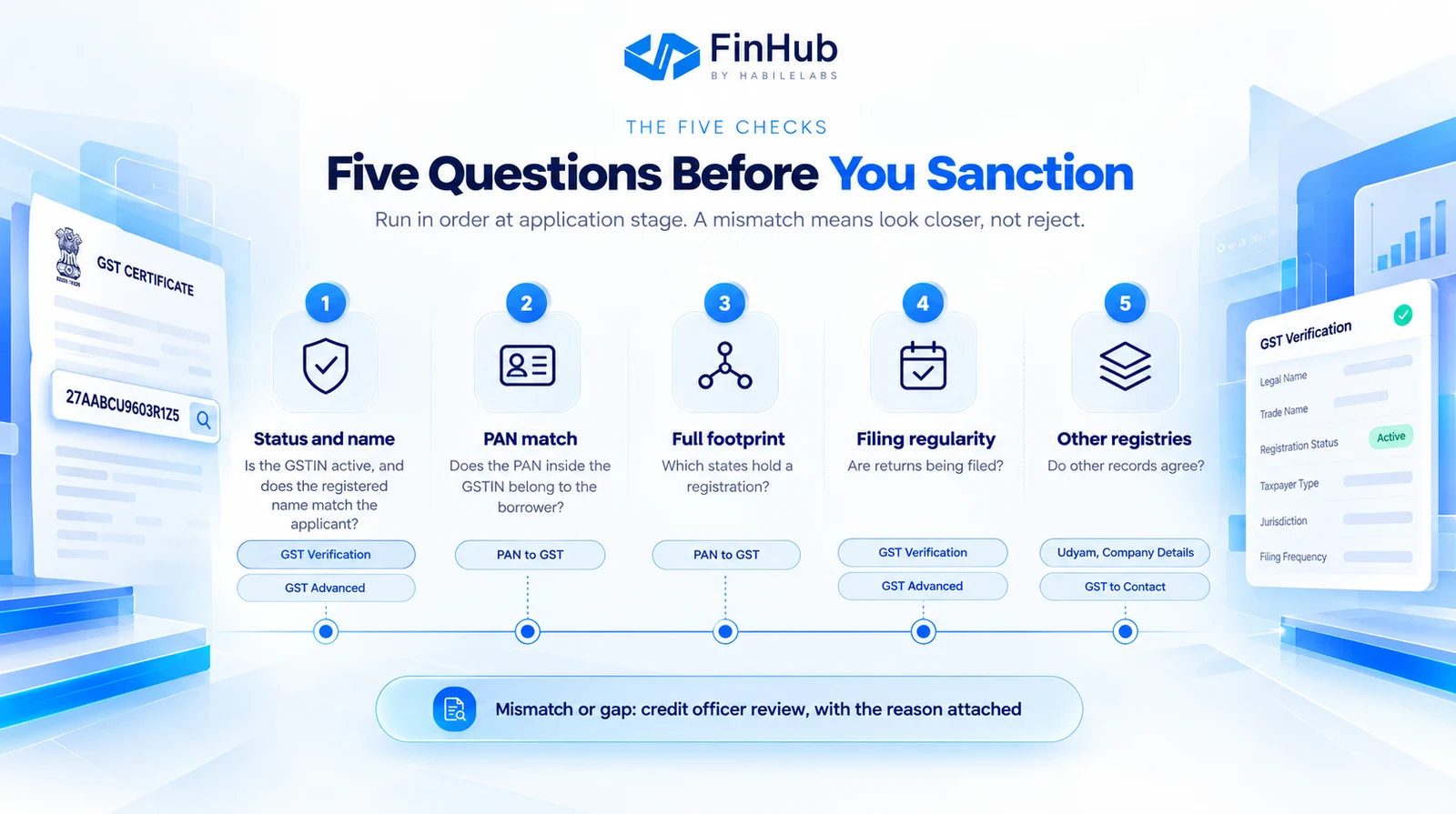
Five checks cover most of what a credit team needs to know about a borrower's GST registration: whether it's live, whose it is, how far it extends, whether it's being used, and whether anything else agrees with it.
| # | Check | What it catches | FinHub API |
|---|---|---|---|
| 1 | Is the GSTIN active, and does the registered name match the applicant? | An inactive or suspended registration, or an application made on behalf of a different entity | GST Verification, GST Advanced |
| 2 | Does the PAN inside the GSTIN match the borrower's PAN? | A GSTIN that belongs to someone else | PAN to GST |
| 3 | What is the borrower's full GST footprint across states? | Registrations the borrower didn't mention, or a footprint that doesn't fit the business | PAN to GST |
| 4 | Are returns being filed regularly? | Dormant or irregular filers | GST Verification for filing status and recency, GST Advanced for filing history |
| 5 | Does the business show up consistently elsewhere? | An identity that holds together on one registry and falls apart on the next | Udyam Verification, Company Details, GST to Contact |
Check 1: Is the GSTIN Active, and Does the Registered Name Match the Applicant?
Start with a live lookup, not the certificate in the file. FinHub's GST Verification API takes the GSTIN and returns the legal and trade name, registration status, taxpayer type, jurisdiction and filing activity, so you can see whether the registration is active today and whose name it's in.
A certificate only tells you a registration existed on the day it was issued. It can't tell you whether it has been suspended since. Once you have the record, put the legal and trade names next to the name on the application and the other business documents. A clean match is routine. A mismatch is the earliest sign that the person applying and the registered business may not be the same entity.
When you want more depth, FinHub's GST Advanced API returns five sections for a GSTIN: basic details, HSN codes, branch details, filing history and a liability-paid summary. And if borrowers upload a certificate, a GST Certificate OCR step, which FinHub's catalog lists, can read the GSTIN into structured fields so nobody retypes it. Reading a certificate isn't verifying it, though, so the extracted GSTIN should still go through the lookup.
Check 2: Does the PAN Inside the GSTIN Match the Borrower's PAN?
Compare the borrower's verified PAN with the PAN built into the GSTIN. A GSTIN is 15 characters: a two-digit state code, then the ten-character PAN of the registered taxpayer, then three more characters. If the PAN inside the number isn't the borrower's, the GSTIN belongs to someone else, whatever the application says. The GST portal is the official source for registration status.
You can do a first pass in a line of code by reading characters three to twelve. For the stronger version, FinHub's PAN to GST API takes the business PAN and returns every GSTIN registered against it. Confirm that the GSTIN the borrower quoted is on that list. If it isn't, stop and ask why before the file goes any further.
Check 3: What Is the Borrower's Full GST Footprint Across States?
Ask for the whole footprint, not the one registration on the form. GST registration is state-wise, so a business operating in several states typically holds a separate GSTIN in each, all tied to the same PAN. The same PAN to GST call returns each registration's legal name, status and state code.

Two questions follow. Does the footprint fit the business the borrower described? A single-location trader with registrations in several states, or a multi-state distributor with only one, both deserve a conversation. And are there registrations the borrower never mentioned? Neither is proof of a problem. Both are cheaper to ask about before sanction than after disbursal.
Check 4: Are GST Returns Being Filed Regularly?
Use filing activity to decide who gets a closer look, not who gets a yes or a no. FinHub's GST Verification API returns filing status and recency, and GST Advanced adds filing history, so the signal arrives with the record instead of as a separate document request. FinHub's catalog also lists a Track Return API.
A registration shows that a business was set up. Filing shows whether it's still running. A long gap, or an irregular pattern, tells your credit team something a certificate can't. But filing regularity doesn't measure creditworthiness, and some good borrowers won't fit the pattern: a seasonal business, a new registration, a filer who's simply late. Its job is routing. Regular filers move on. Irregular ones go to a credit officer with the reason attached.
Check 5: Does the Business Show Up Consistently Across Other Registries?
A genuine business usually leaves a consistent trail: the same name, PAN and address in more than one place. A borrowed or fabricated identity tends to hold together on one registry and fall apart on the next. Which registries apply depends on how the borrower is constituted. The primary sources are the Udyam registration portal, the MCA portal and the GST portal.
- MSME registration: FinHub's Udyam Verification API validates a Udyam Registration Number and returns the enterprise name, classification (micro, small or medium), activity type and registration status.
- Company records: The Company Details API takes a CIN and returns the company name, directors, registration details, a financial summary and MCA compliance status.
- Contact details: GST to Contact returns the registered email and mobile, the entity name and a match status, which makes it quick to compare against the contacts on the application.
FinHub's catalog also lists GST from Company Name, for applicants who give a company name but no GSTIN. An entity that appears in only one place, or whose details change from one registry to the next, should go to manual review before anything is sanctioned.
How the Five Checks Work Together in One Onboarding Flow
Run the five checks in order at the application stage, and send anything that does not line up to a credit officer instead of rejecting it automatically.
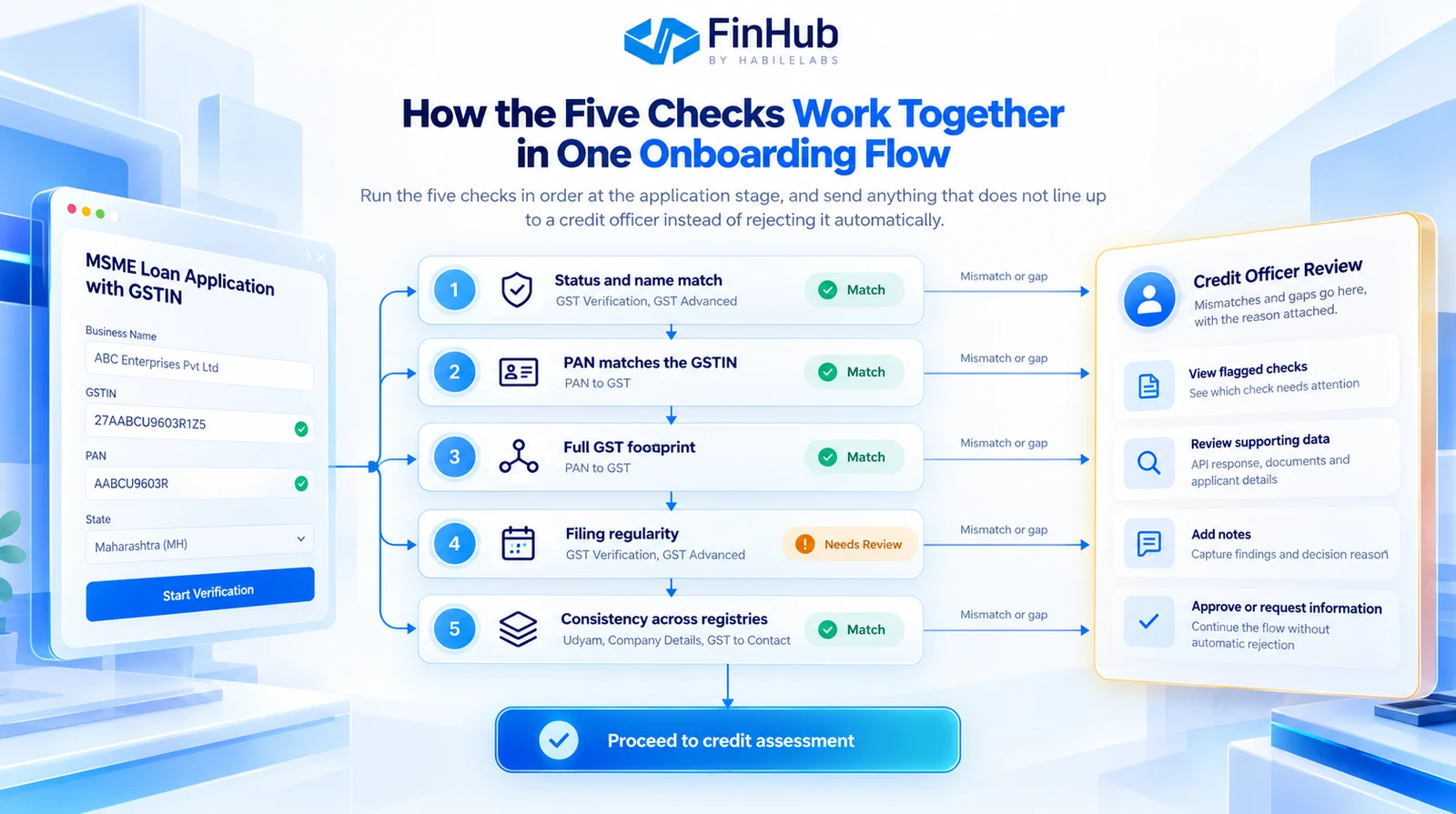
A mismatch on any check is a reason to look closer, not a verdict. Attach the reason to the file when it goes to a credit officer, and keep each check's result with the application so the decision can be reviewed later.
What Should You Do When a GST Check Fails?
A failed check is a prompt to ask a question. It isn't a verdict on the borrower. The table shows a sensible first response to each.
| Check | What you see | Likely cause | What to do |
|---|---|---|---|
| 1. Status and name | Registration isn't active, or the name differs | A different entity, a trade name in use, or a suspended or cancelled registration | Ask for the right GSTIN or an explanation. Don't proceed on the number as quoted |
| 2. PAN match | The borrower's PAN isn't behind the GSTIN | The GSTIN belongs to someone else | Stop and ask before the file moves |
| 3. Footprint | States you didn't expect, or fewer than expected | Undeclared registrations, or a footprint that doesn't fit the business | Ask the borrower and note the answer on file |
| 4. Filing | Gaps or an irregular pattern | A seasonal business, a new registration, or a dormant one | Send to a credit officer with the reason. Don't auto-reject |
| 5. Other registries | Details disagree across sources | Name changes, typing errors, or an identity that doesn't hold together | Manual review before sanction |
Want to see how these five checks would sit in your own onboarding flow? Request a 30-minute architecture review
What Can GST Checks Not Tell You?
GST checks tell you a registration is real, whose it is and whether it's being used. They don't tell you whether the borrower can repay. Treat them as one layer of business verification, not as a credit decision.
- Repayment capacity: Filing activity shows a business is running, not how profitable it is. Pair it with statement and financial analysis, which we cover in our post on bank statement analysis for credit decisions.
- Businesses without GST: Some small businesses aren't required to register for GST at all. A missing GSTIN calls for a different route, such as Udyam or company records, not an automatic rejection.
- The people behind the business: GST verification checks the entity. The proprietor or promoters still need KYC, which our NBFC KYC guide walks through.
Once the entity checks out, make sure the money lands in the right account. Our guide to bank account verification methods shows how lenders choose between penny drop, penny-less and UPI.
What Does GST Verification Cost?
FinHub prices verification APIs per successful call, so you pay for results, not attempts. The per-call rate falls in higher volume bands, and there's no published rate card. Pricing is put together around the APIs you choose and the volumes you expect.
It helps to decide your approach before you ask for a quote. A team that runs all five checks on every application will have a different volume and API mix from one that runs the first two on everything and the rest only when something looks off. See how FinHub prices its APIs for the full model.
Here's a rough model to fill in. Monthly calls equal applications times the checks you run on each one. The numbers below are made up to show the arithmetic. They aren't FinHub data, so use your own.
| Input | Illustrative example | Your number |
|---|---|---|
| MSME applications per month | 8,000 | |
| Checks 1 and 2 on every application | 16,000 calls | |
| Share flagged for checks 3 to 5 | 30%, so 2,400 applications | |
| Up to three further calls each | 7,200 calls | |
| Monthly verification calls | Up to 23,200 |
Is Your MSME Onboarding Ready for These Checks?
Six questions tell you most of what an architecture review would. Answer them for your current flow.
| Question | If yes | If no |
|---|---|---|
| Do you check the GSTIN live, rather than from the certificate? | You know its status today | Add a live lookup at application stage |
| Do you compare the PAN inside the GSTIN with the borrower's PAN? | Borrowed numbers get caught early | Add the PAN match before any other check |
| Do you look at every GSTIN under the PAN, not just the one quoted? | You see the whole footprint | Pull the full list and compare it with the borrower's story |
| Are filing gaps routed to a credit officer instead of auto-rejected? | Seasonal and new filers aren't lost | Change the rule from reject to review, with the reason attached |
| Do you have a route for borrowers without a GSTIN? | Udyam or company records fill the gap | Define the alternative path before you need it |
| Is each check's result stored with the application? | Decisions can be reviewed later | Store result, timestamp and consent reference per check |
Mostly "no"? That's a normal place to start, and a good reason to bring your flow to an architecture review.
Talk to FinHub About GST and Business Verification for MSME Lending
In a 30-minute architecture review, we'll look at where these five checks fit in your MSME journey, which APIs you need at each step, and where mismatches should route. Bring your current flow and your expected volumes, and we'll work from those.
To make the session useful, have these to hand:
- Journey: where MSME onboarding starts and where credit review begins.
- Volumes: applications per month and the share you flag today.
- Borrower mix: proprietors, partnerships and companies, and how many lack a GSTIN.
- Current rules: what happens today on a name mismatch or a filing gap.
- Stored data: which check results you keep with each file.
Request a 30-minute architecture review
Prefer to browse first? See the full set of GST verification APIs.