Pranshi Mittal
· 6 min read
In short: Most delays in loan approvals aren't caused by underwriting decisions, they're caused by outdated assumptions about what document processing can and can't do. FinHub's Smart OCR processes 25+ document types in multiple languages and returns structured data, not just a scanned block of text, for documents like bank statements, salary slips, PAN, Aadhaar, ITRs, and loan agreements. Here are the five beliefs still slowing BFSI teams down, and what's actually true.
Even after digital onboarding, document collection and verification remain one of the slowest parts of the loan journey. That's the gap AI-powered OCR solutions for lending are built to close, with document-specific OCR translation for BFSI documents instead of one generic engine stretched across every type.
Myth 1: Manual Review Is More Accurate Than OCR
Reality: Manual review depends on a person correctly reading and retyping every field, on every document, every time. That's where transcription errors, missed fields, and inconsistent formatting actually come from. Smart OCR doesn't get tired on the fiftieth bank statement of the day. It extracts each field the same way, every time, and hands your underwriting team a consistent, structured record to review instead of a stack of scans to retype. The accuracy question isn't OCR versus a person, it's a repeatable automated process versus a manual one that varies by document, by reviewer, and by how late in the day it is. That's also the difference underwriters feel day to day: a consistent structured record waiting for them instead of a stack of scans still being retyped, which is what turns document review from your slowest onboarding step into one you barely have to think about.
Myth 2: OCR Can't Handle Real-World Documents
Reality: This myth usually comes from experience with a single, generic OCR engine that was never built for financial documents in the first place. A bank statement, a salary slip, a PAN card, and a loan agreement don't share a layout, a format, or the kind of data that matters on them, so treating them with one generic model is where the real-world failures come from. FinHub's Smart OCR processes 25+ document types, including bank statements, salary slips, PAN, Aadhaar, passports, cheques, ITRs, insurance policies, and loan agreements, each handled by a model built for that specific document rather than one generic engine stretched across every type. It also reads documents in multiple languages, not just English, so a regional-language salary slip or bank statement isn't treated as a special case. That's the difference between an AI-based OCR development service built generically, and optical character recognition for financial services purpose-built for the documents BFSI teams actually collect.
Myth 3: OCR Only Extracts Text, It Doesn't Tell You Anything Useful
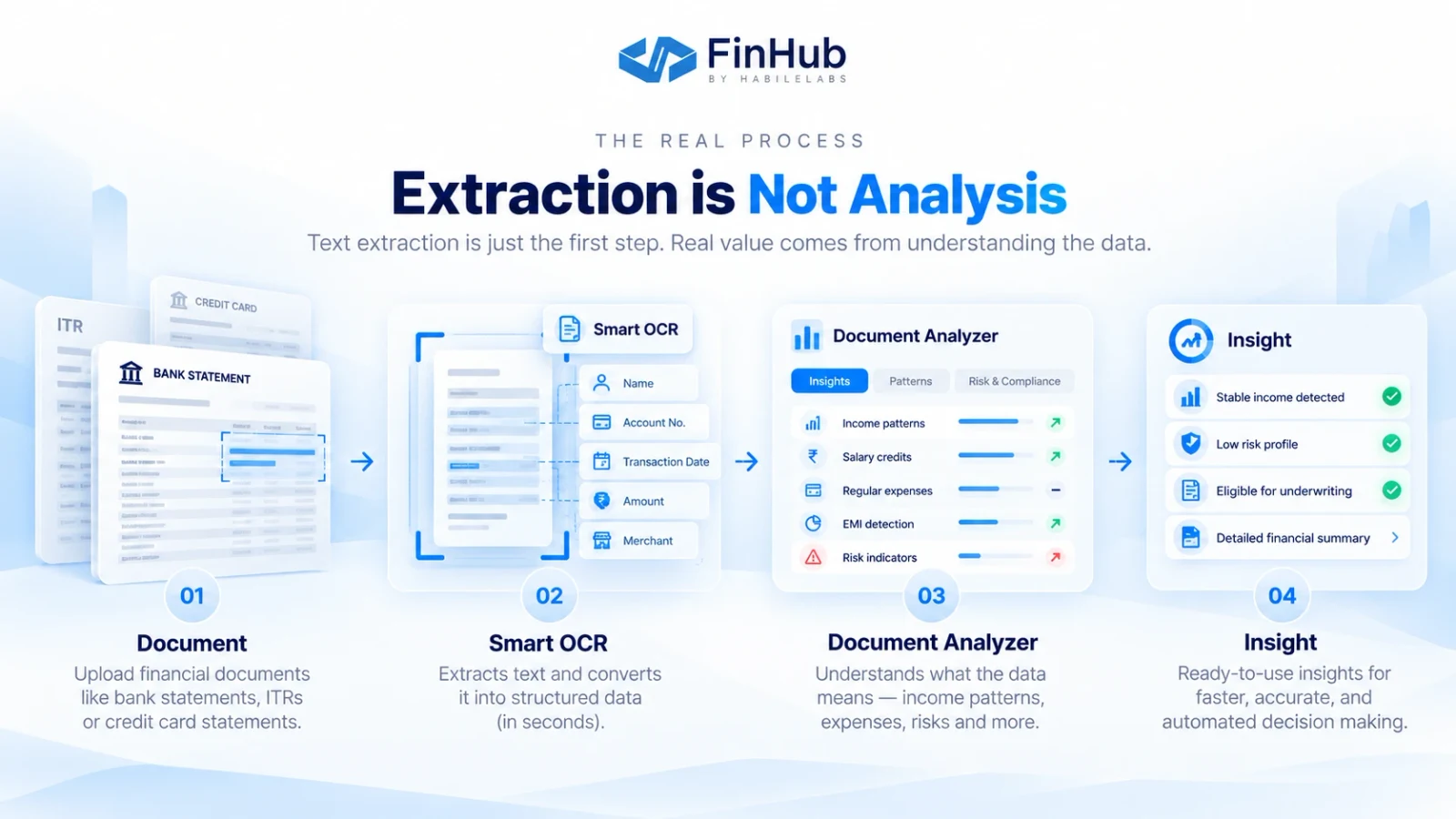
Reality: Extraction and analysis are two different jobs, and this myth conflates them. FinHub's Smart OCR doesn't just read text off a page, it returns structured data, ready-to-use fields your system can act on directly. FinHub's Document Analyzer suite goes further: the Bank Statement Analyzer, ITR Analyzer, and Credit Card Analyser read what's actually in a financial document, not just what the fields say, so an underwriting team gets income patterns and financial context, not just a payslip OCR output sitting in a folder. Treating OCR as a dead end after extraction is exactly why some BFSI teams still do the actual financial review by hand, on top of the automation they already paid for.
Myth 4: Automating Document Processing Means Losing Audit Control
Reality: The opposite tends to be true. A manual process produces whatever a reviewer happened to write down, in whatever format they happened to use that day, which is genuinely hard to audit consistently after the fact. A structured, automated extraction produces the same fields, in the same format, for every application, which is a more consistent and more reviewable record than a pile of handwritten notes or inconsistent spreadsheets ever was. Automation done well doesn't remove human oversight, it gives that oversight something consistent to actually review.
Myth 5: Smart OCR Is Only Useful for KYC, Not the Full Loan Journey
Reality: KYC is usually where document automation starts, and where it stops. But the same underlying need, extracting structured data reliably from a document, runs through the entire loan lifecycle: KYC documents like Aadhaar, PAN, and passports at onboarding; income and eligibility documents like salary slips, ITRs, and bank statements at underwriting; and servicing documents like loan agreements and cancelled cheques after disbursal. An AI-based OCR solution that only covers the KYC step still leaves the rest of the loan journey running on manual review.
What BFSI Teams Should Actually Look For
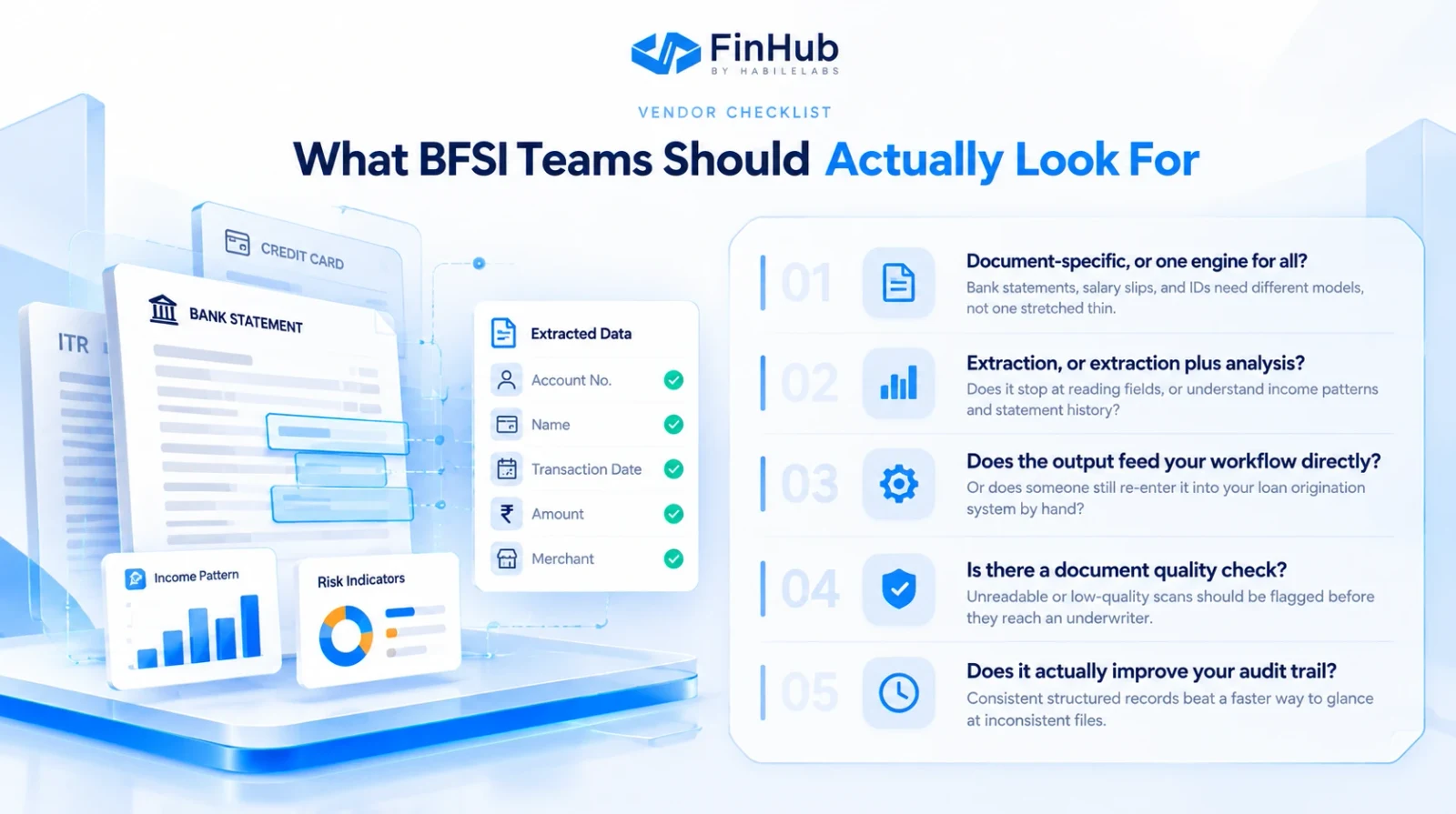
If you're evaluating document processing for your lending or onboarding stack, these are the questions worth asking before you commit to one:
- Does it use document-specific models built for bank statements, salary slips, and ID documents separately, or one generic OCR engine stretched across every document type?
- Does it stop at text extraction, or does it also analyze what's in the document, income patterns, statement history, not just the raw fields?
- Does the output feed directly into your existing loan origination or KYC workflow, or does someone still have to re-enter it manually?
- Is there a document quality check step that flags unreadable, incomplete, or low-quality scans before they reach an underwriter?
- Does the automated output actually improve your audit trail, consistent structured records your compliance team can review, rather than just a faster way to glance at a file?
See How FinHub's OCR and Document Analyzer APIs Work Together
Moving beyond legacy OCR isn't just about speed, it's about turning unstructured paper into structured, audit-ready records across the entire loan journey, from KYC documents through income verification to loan servicing. If document collection and review is still the slowest part of your loan journey today, FinHub's team can walk you through the specific Smart OCR and Document Analyzer APIs relevant to your existing onboarding and underwriting stack.