Pranshi Mittal
· 11 min read
Want this mapped to your own loan flow? Request a 30-minute architecture review
Most lenders find out what a wrong account number costs when a disbursal bounces. Someone in operations chases the customer, the customer gets annoyed, and a loan that should have gone out on Tuesday goes out on Friday. The worse version is a payout that lands in someone else's account and is hard to pull back.
The fix is a check before the money moves. The catch is that bank account verification isn't one thing. Penny drop, penny-less and UPI checks ask different things of the customer and confirm different things about the account, and the one that suits application stage may not be the one you want at disbursal.
RBI's digital lending guidelines require disbursals to go straight into the borrower's bank account, so the account has to be right the first time. Below, we compare the methods, show where each one belongs in a loan journey, and cover what to do when a check fails.
Which Bank Account Verification Methods Are There?
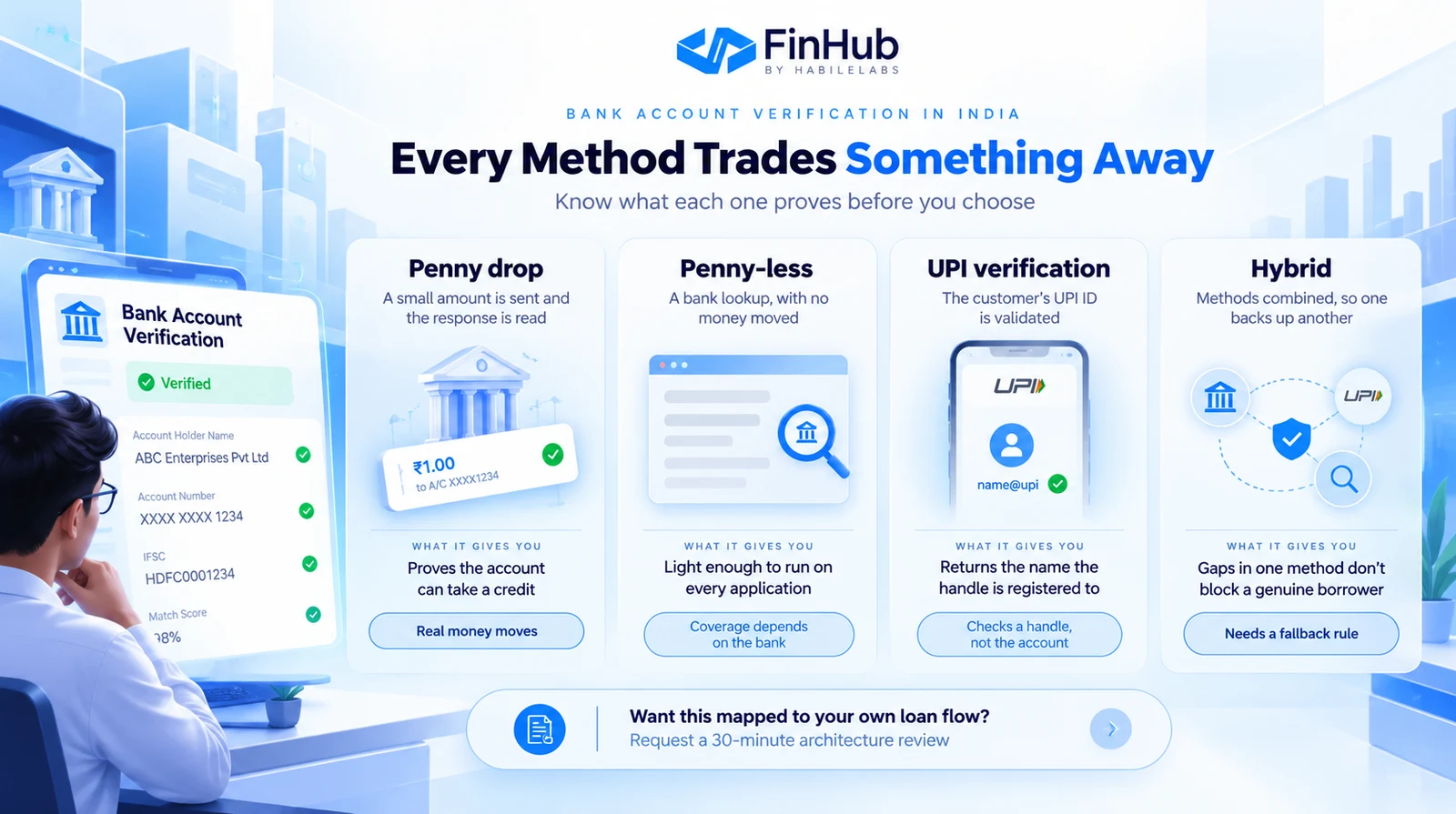
Four methods cover most lending use cases: penny drop, penny-less, UPI verification and hybrid. They differ in whether money moves, what the customer has to type, and what the check actually proves. The table compares them side by side.
| Method | How it works | What it confirms | Choose it when | FinHub API |
|---|---|---|---|---|
| Penny drop | A small amount is sent to the account and the bank's response is read | The account is valid and active, plus the registered beneficiary name | You want proof the account can actually receive a credit | Bank Account Verification |
| Penny-less | The account is checked through a bank lookup and no money moves | Account validity and, where the bank returns it, the holder name | You screen at volume and don't want to move money on every application | Bank Account Verification |
| UPI verification | The customer's UPI ID is validated and the registered name returned | The UPI handle exists, and who it is registered to | UPI is the rail you will collect or pay on | UPI Verification |
| Hybrid | Methods are combined so one can back up another | Depends on the methods combined | Your borrowers bank with many different banks | Hybrid Bank Account Verification |
Before any of these, validate the IFSC. FinHub's IFSC Validation API confirms the code is valid and returns the bank, branch, address, MICR code and branch contact details. UPI Verification and Hybrid Bank Account Verification sit alongside it in FinHub's API catalog.
How Does Each Method Work, and Where Does It Fall Short?
Every method trades something away. Penny drop gives the strongest proof and moves real money. Penny-less is lighter but depends on how the bank responds. UPI is quick but checks a handle, not an account. Hybrid closes some of those gaps by combining methods.
Penny drop
Penny drop is the closest thing to a real test. A small amount goes to the account, and the response tells you whether the account is live and who it's registered to. If you need to know the account can take a credit before the actual disbursal, nothing else gives you that. The price is that real money moves, so the check leans on the payment rails being up at that moment, and it's a heavier thing to run on every single application.
Penny-less
Penny-less checks the account through a bank lookup and moves nothing. There's nothing to reconcile and nothing to refund, which makes it an easy default for screening at application stage. The catch is coverage. FinHub's own product page describes penny-less as available "where supported", so plan a fallback for the accounts a lookup can't resolve.
UPI verification
Here the customer gives you a UPI ID instead of an account number, and you get back the name it's registered under. That's the natural fit when UPI is how you'll collect or pay, and NPCI runs the rail underneath. Just remember it validates a handle, not the bank account behind it. If you disburse by bank transfer, check the bank account itself.
Hybrid
A hybrid setup stops one method's gaps from deciding who gets through. The lighter check runs first, and another method steps in when it returns nothing. In practice that means fewer applications stuck in a review queue for reasons that have nothing to do with the borrower.
Matching the name, whichever method you use
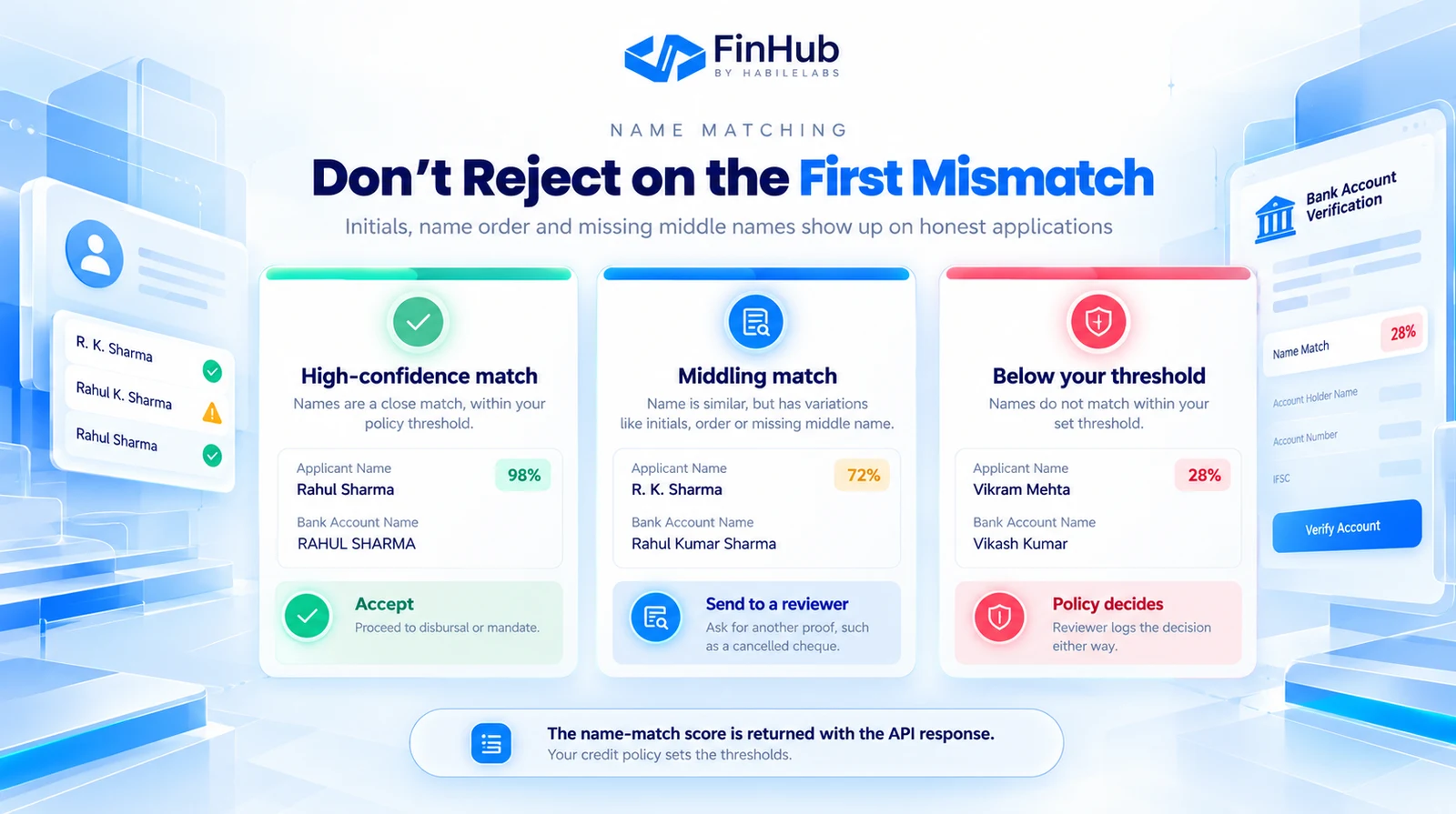
Whatever you choose, you're comparing a name the bank returns with a name the customer typed. Initials, name order and a missing middle name will throw up mismatches on perfectly honest applications. FinHub's API sends back the registered beneficiary name along with a name-match score, so the decision becomes a threshold your credit policy sets. Accept the high matches, send the middling ones to a person, and don't reject on the first mismatch.
Which Method Should You Use at Each Step of the Loan Journey?
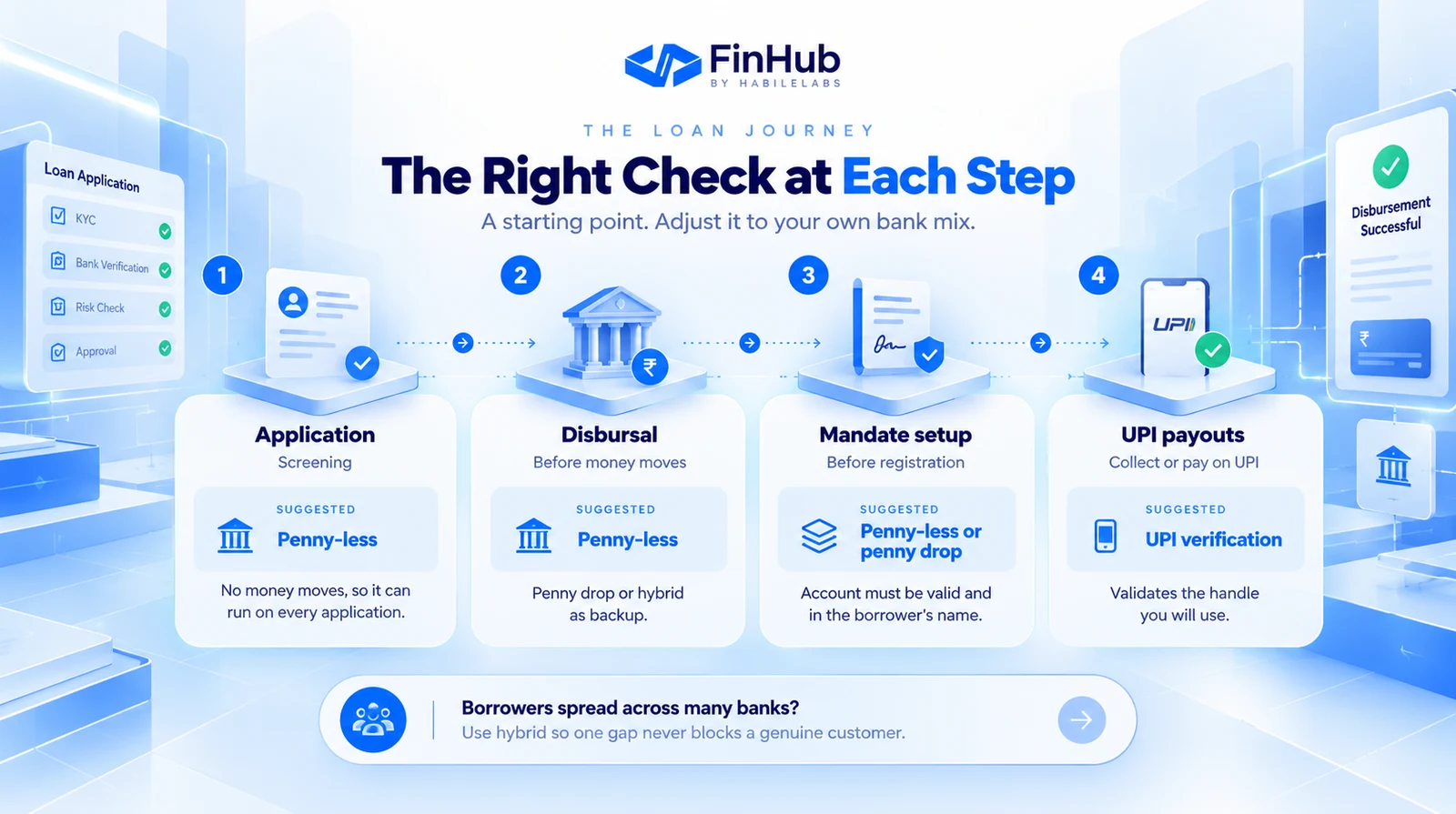
Start with a no-money check and keep penny drop in reserve. That's a sensible default, and your risk and operations teams should adjust it to your own bank mix. The table gives a starting point for each step.
| Use case | Suggested method | Why |
|---|---|---|
| Loan disbursal to the borrower's account | Penny-less, with penny drop or hybrid as backup | Confirms the account and holder name before money moves, and gives you a stronger check when you want proof of a live credit |
| Repayment mandate setup | Penny-less or penny drop | The account has to be valid and in the borrower's name before the mandate is registered |
| UPI-first payouts or collections | UPI verification | Validates the handle you will actually use |
| Screening at application stage | Penny-less | No money moves, so it can run on every application without adding friction |
| Borrowers spread across many banks | Hybrid | A coverage gap in one method doesn't block a genuine customer |
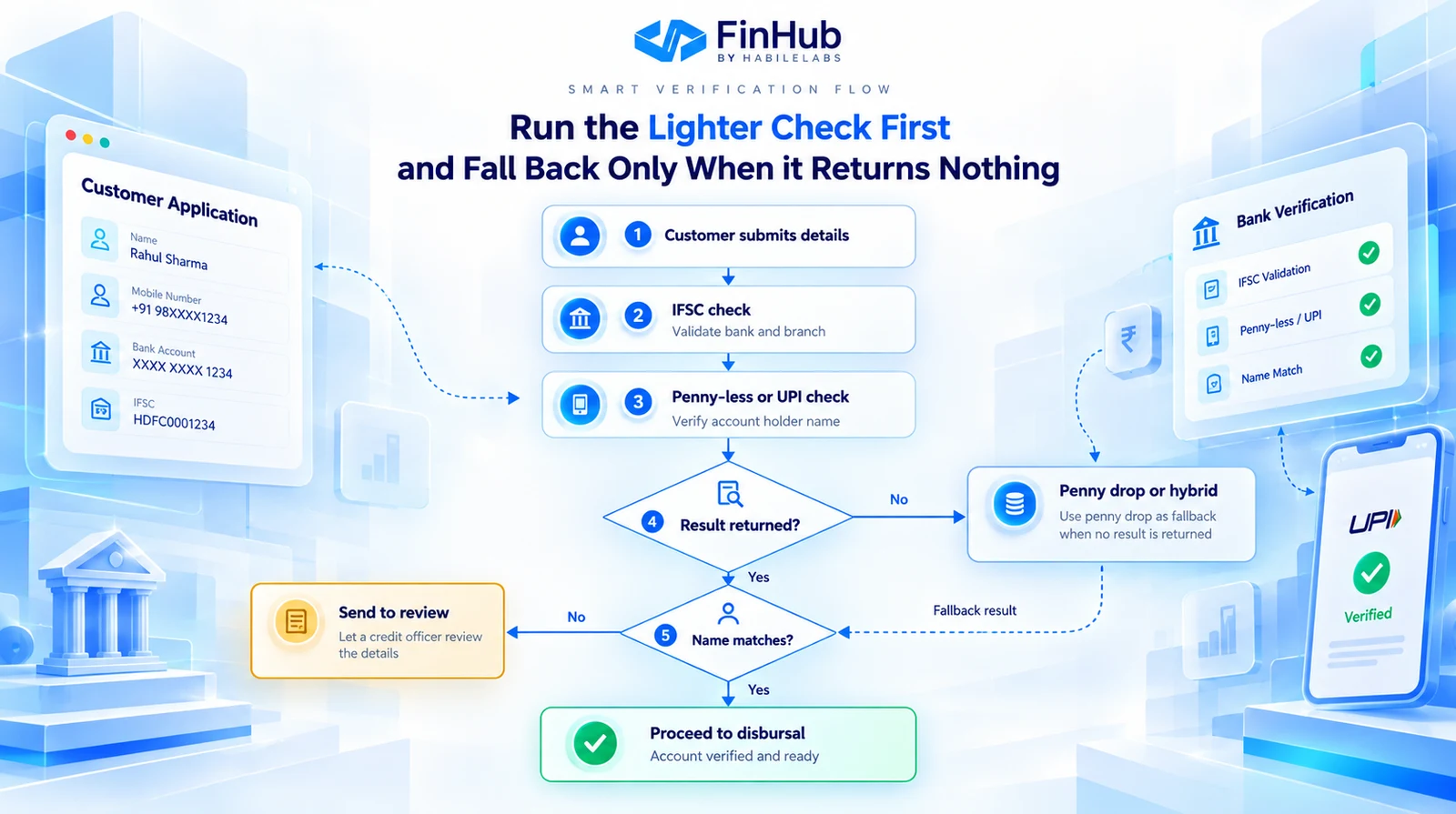
The lighter check runs first. The fallback method runs only when it returns nothing, and a name that does not match goes to a reviewer instead of being rejected outright.
Not sure which mix suits your bank base? We can look at your actual flow. Request a 30-minute architecture review
What Does Bank Account Verification Cost?
FinHub prices verification APIs per successful call, so you're billed on results, not attempts. The unit rate comes down as volume goes up. FinHub doesn't publish a rate card, so the exact figure comes from a conversation about which APIs you need and what volumes you expect.
For budgeting, three things will move the number: how many verifications you run each month, which methods you combine, and how often a fallback fires. A lender that screens every application with a no-money check and keeps penny drop for exceptions will have a different bill from one that runs penny drop on every disbursal. See how FinHub prices its APIs for the full model.
Here's a back-of-envelope model you can fill in before the call. Monthly calls equal applications, times the share that reach verification, times one plus your fallback rate. The numbers below are made up to show the arithmetic. They aren't FinHub data, so swap in your own.
| Input | Illustrative example | Your number |
|---|---|---|
| Applications per month | 10,000 | |
| Share that reach verification | 60%, so 6,000 primary checks | |
| Fallback rate | 15%, so 900 extra calls | |
| Monthly verification calls | 6,900 |
One question worth asking on the call: how is a no-result response billed? It affects how you size the fallback.
What Should You Do When Verification Fails?
A failed check isn't always a bad customer. Most failures fall into three groups, and each one needs its own response.
| What you see | Likely cause | What to do |
|---|---|---|
| Name mismatch | Formatting differences such as initials or name order, or an account held by someone else | Use the name-match score. Accept high-confidence results and send the rest to review. Ask for another proof, such as a cancelled cheque, if the doubt remains |
| Account not found or inactive | A mistyped number or IFSC, or a closed or dormant account | Ask the customer to re-enter the details instead of retrying the same request |
| No result returned | A bank coverage gap or temporary unavailability | Retry once, then fall back to another method |
When the details look off, a cancelled cheque makes a useful second source. FinHub's Cancelled Cheque OCR API reads the cheque image and extracts the account number, IFSC code and bank name, plus the account holder name if it's printed. Reading a cheque isn't the same as verifying an account, so run what it extracts through the verification check. And log every attempt with its result and the decision taken, so the audit trail shows why an account was accepted or turned away.
When Is Bank Account Verification Not Enough?
Account verification tells you the account exists and who holds it. It doesn't tell you whether the borrower can repay, or whether the person applying is who they say they are. Treat it as one control among several.
- Repayment capacity: A verified account says nothing about income or cash flow. For that you need to read the statements, which we cover in our post on bank statement analysis for credit decisions.
- Who is applying: Matching the account name to the application supports KYC but doesn't replace it. Our NBFC KYC guide covers the identity side.
- Which account it is: The account a borrower gives you may not be the one their income lands in, so don't read it as a picture of their finances.
Lending to a business rather than an individual? Then the account is only half the picture. Our post on GST verification checks for MSME loans covers verifying the entity behind it.
What Does FinHub's Bank Account Verification API Take In and Return?
You send the account number and IFSC, along with a consent artifact and, if you have one, the name you expect. You get back account validity and status, the registered beneficiary name, a name-match score, and the bank and branch resolved from the IFSC. The result is sealed to your audit trail before any money moves.
- Inputs: Account number, IFSC, an optional expected name and a consent artifact.
- Outputs: Account validity and status, registered beneficiary name, name-match score, and bank and branch from the IFSC.
- Method: Real-time penny drop, with penny-less where supported.
- Audit trail: Every check is logged, which is the first thing an auditor will ask to see.
The full detail is on the Bank Account Verification API page. If you're weighing providers, see how FinHub compares with other KYC API providers.
Is Your Bank Verification Flow Ready for Scale?
Six questions tell you most of what an architecture review would. Answer them for your current flow.
| Question | If yes | If no |
|---|---|---|
| Do you verify the account before disbursal rather than at it? | Errors surface while the borrower is still engaged | Move the check to application or sanction stage |
| Is there a defined fallback when the first method returns nothing? | Coverage gaps don't strand genuine borrowers | Add a second method and a retry rule |
| Does a consent artifact travel with every check? | You can show why the data was fetched | Capture consent before the call, not after |
| Is the name-match threshold set by credit policy? | Mismatches route the same way every time | Agree accept, review and reject bands with risk |
| Is every attempt logged with its result and the decision taken? | Audit questions have answers | Log request, result, decision and reviewer |
| Can operations see failures by reason? | You fix causes instead of chasing cases | Report mismatch, not-found and no-result separately |
Mostly "no"? That's a normal place to start, and a good reason to bring your flow to an architecture review.
Talk to FinHub About Your Bank Verification Flow
In a 30-minute architecture review, we'll look at where bank account verification sits in your journey, which method suits each step, and how your fallbacks should route. Bring your current flow and your expected volumes, and we'll work from those.
To make the session useful, have these to hand:
- Current flow: a rough diagram of where account details are captured and checked.
- Volumes: applications per month and the share that reach disbursal.
- Bank mix: the banks your borrowers use most.
- Failure data: how many disbursals bounce today, and why.
- Policy: your current rule for name mismatches.