Pranshi Mittal
· 10 min read
Everything below about Signzy and the other nine platforms is drawn directly from each company's own website, as publicly published at the time of writing (September 2026). Nothing here is FinHub's opinion of a competitor's product, and nothing is stated as a weakness unless the vendor itself frames it that way. Vendors update pricing, features and numbers often, so if this is going to inform a real purchase decision, confirm the current details directly with the vendor before you shortlist. The same discipline applies to the FinHub details in this piece.
Why This List Exists
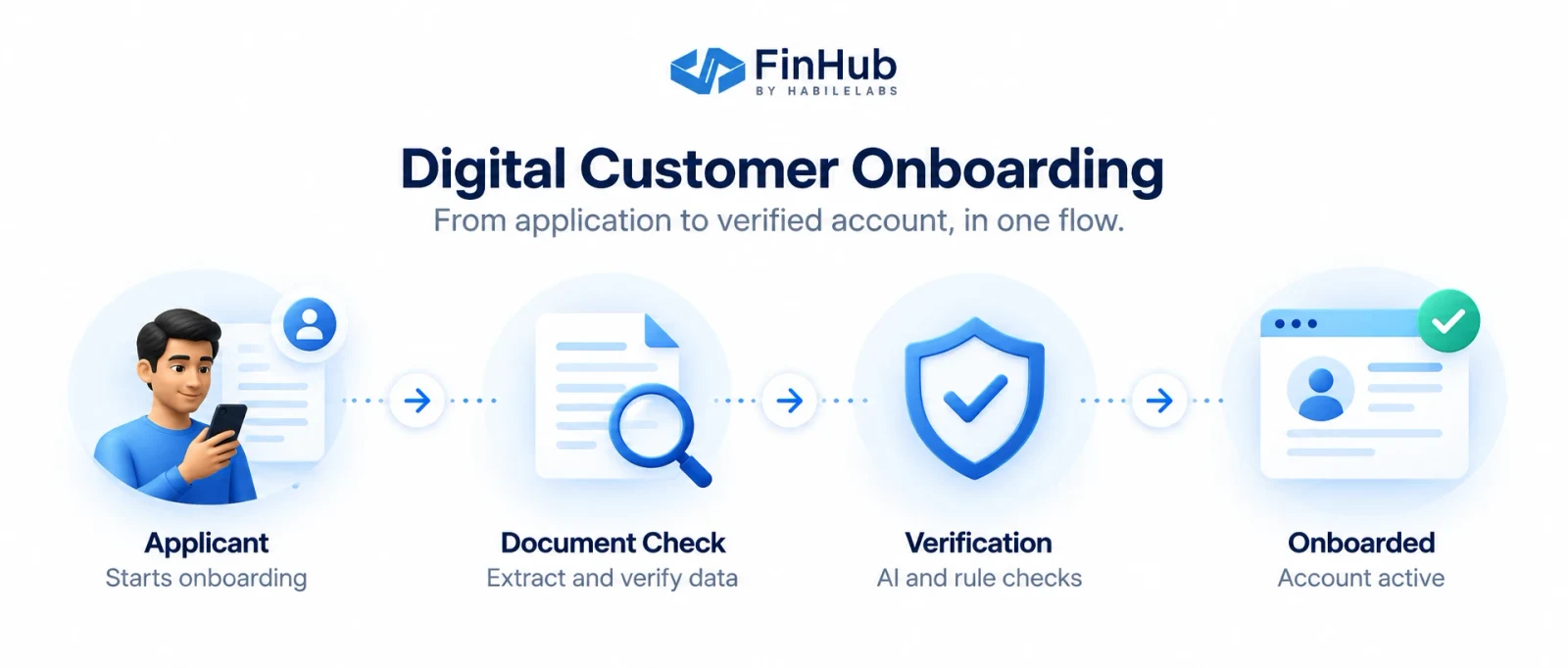
If you lead onboarding, compliance, risk or technology at a bank, NBFC, insurer or fintech lender, you've probably had to evaluate vendors for NBFC KYC onboarding or broader digital customer onboarding at some point, and Signzy is one of the more visible names in that space. This piece lays out ten platforms BFSI teams in India commonly evaluate alongside or instead of Signzy for their digital lending platform or onboarding stack, including FinHub, by HabileLabs, so you have a factual reference point while you build your own shortlist. It is not sponsored, and it is not a ranking.
How to Read This Comparison
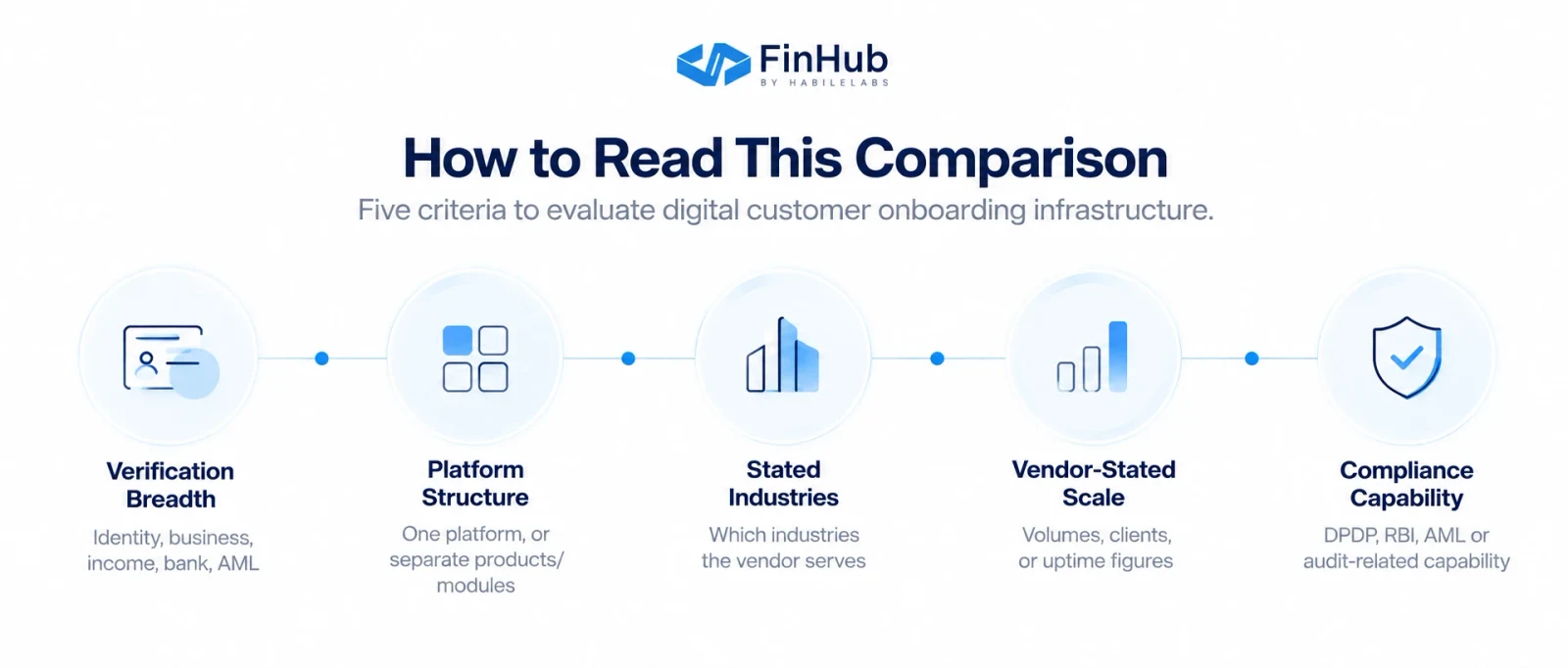
Rather than ranking vendors, this piece organizes each one against five criteria that matter to a BFSI buyer evaluating digital customer onboarding infrastructure:
- Verification breadth. What categories of checks does the platform publicly list (identity, business, income, bank, vehicle, AML)?
- Platform structure. Is it presented as one integrated platform, or as separate products/modules?
- Stated industry focus. Which industries does the vendor say it serves?
- Scale, as stated by the vendor. Verification volumes, client counts, or uptime figures the company publishes about itself.
- Compliance-related capabilities. Any DPDP, RBI, AML or audit-related capability the vendor specifically names.
Every entry below includes only what each company states about itself publicly. Where a category isn't mentioned on a vendor's site, it's left blank rather than assumed absent, since a vendor may simply not publish every detail online.
Signzy, and Ten Alternatives Worth Evaluating
Signzy runs an API-based platform covering identity verification, business verification, background checks, credit assessment and fraud detection, including deepfake detection, with separate stacks for the US, Middle East and India markets. Its site states it serves 500+ companies, naming examples including Amazon Pay, ICICI Bank and HSBC, and says it has processed 1 billion+ verifications, under the tagline "The Global Standard for Securing User Journeys."
The most commonly evaluated Signzy alternatives for BFSI and NBFC digital customer onboarding in 2026 are HyperVerge, Surepass, IDfy, AuthBridge, Digio, Perfios, FinBox, Bureau, Deepvue and FinHub, profiled below:
- HyperVerge is an end-to-end eKYC and onboarding stack known for video KYC (agent-assisted and agentless) and liveness and deepfake detection, which it states is ISO 30107-3 Level 2 certified, alongside OCR, document intelligence, AML screening and face deduplication. Its site states 2 billion+ identity verifications processed across 500+ enterprise customers, serving digital banks, lending and BNPL providers, fintechs, insurers and government bodies. Best for: teams whose top priority is video KYC quality and deepfake/liveness fraud detection at scale.
- Surepass offers a broad API catalogue covering identity verification (Aadhaar, PAN, passport, driving licence, voter ID), business verification (GST, MCA, TAN, Udyam), income verification, video KYC, e-sign, vehicle checks and credit reports. Its site states it serves 3,000+ companies, including HDFC Bank, IDFC First Bank and Paytm, and says it can reduce onboarding cost by up to 80%. Best for: buyers prioritizing broad API coverage and lower per-verification cost.
- IDfy positions itself as "Asia's leading TrustStack," built across three platforms: OnboardIQ for onboarding and KYC, OneRisk for risk detection, and Privy for DPDP-related data governance. Its site states 70 million+ monthly verifications, 500+ clients across seven countries, ISO 27001 and SOC 2 Type 2 certification, and names NBFCs writing vehicle and housing loans specifically among its served industries. Best for: NBFCs writing vehicle and housing loans specifically, a segment IDfy names directly.
- AuthBridge built its name in background verification and employee screening, and has expanded into customer-facing KYC, video KYC, AML checks and third-party due diligence. Its site states 3,000+ clients across 140 countries and 15 million+ verifications a month, serving banking and financial services, NBFCs, insurance, healthcare and e-commerce. Best for: organizations that need employee and vendor due diligence alongside customer KYC.
- Digio centres on e-signing and consent infrastructure, with DigiSign for Aadhaar e-sign, DigiKYC for DigiLocker-based verification, and newer modules CoTrust (DPDPA consent management) and DigiShield (sanctions screening). Its site states up to 95% reduced turnaround time and 60% reduced operational cost, serving banks, NBFCs, insurers and capital markets firms. Best for: teams whose main bottleneck is e-signing and consent capture rather than identity checks themselves.
- Perfios focuses on financial statement analysis and credit decisioning through Perfios Insights, including bank statement scoring and tax document automation (Form 26AS, ITR). Its site states auto-fetch support for 250+ financial institutions and 1,000+ e-statement formats, positioned as "Made in India, Made for India" for underwriting rather than identity verification specifically. Best for: underwriting and credit decisioning depth rather than identity verification breadth.
- FinBox describes itself as the "operating system for digital lending," bundling loan origination (Superflows), decisioning (Sentinel), income analytics (BankConnect) and alternative data (DeviceConnect), with KYC and KYB presented as part of that broader lending stack. Its site states 130+ partner integrations across 2,000+ systems and names IIFL Finance and Muthoot FinCorp as clients. Best for: NBFCs replacing their entire digital lending platform and decisioning stack, not just the KYC step.
- Bureau runs a unified risk decisioning platform combining device intelligence, behavioral biometrics, identity and business verification, and graph-based detection of mule accounts and fraud rings. Its site names fintech, e-commerce, marketplaces, online gaming and dating platforms alongside financial services as served industries, under the tagline "Real-Time Fraud Prevention & Identity Decisioning." Best for: fraud-first, device-and-behavior-driven risk decisioning, including outside core BFSI use cases.
- Deepvue describes itself as "the decisioning platform built on India Stack," consolidating DigiLocker-based KYC, Aadhaar, PAN, voter ID and passport checks behind one API, along with liveness, face match, device intelligence and PEP/sanctions screening. Its site states 15 million+ decisions processed, 99.99% uptime and sub-200ms average latency, naming DollarPe and Lark Finserv as clients. Best for: teams comfortable evaluating a newer, India Stack-native platform still building out its decisioning layer.
- FinHub, by HabileLabs, is built specifically as onboarding and compliance infrastructure for BFSI, offered as one integrated platform rather than separate products. It publishes 100+ KYC and verification APIs spanning identity verification, business verification, income verification, bank account verification, vehicle verification, AML and PEP screening, video KYC, Aadhaar e-sign, Smart OCR across bank statements, PAN, GST and ITR, and credit reports, all behind a single integration with a Consent Engine that logs every API call for DPDP and RBI audit review. Its site states onboarding cycles reduced from three days to under six minutes, and its customers include NBFCs and lenders such as Aavas Financiers and Utkarsh Small Finance Bank. Best for: BFSI and NBFC teams consolidating multiple onboarding vendors into one BFSI KYC platform with a single DPDP/RBI-ready audit trail.
Comparison Reference Table
This table restates only what's confirmed in the profiles above. A blank cell means that category wasn't specified on the vendor's public pages as of this writing, not that the vendor lacks it.
| Platform | Verification breadth (stated) | Platform structure | Stated industries | Scale (vendor-stated) | Compliance capability named |
|---|---|---|---|---|---|
| Signzy | Identity, business, credit, fraud, deepfake detection | Modular API marketplace, regional stacks | BFSI, big tech, crypto | 500+ companies, 1B+ verifications | AML/fraud detection modules |
| HyperVerge | Identity, video KYC, OCR, AML, face dedup | Single onboarding stack | Digital banks, lending, insurance, gov | 2B+ verifications, 500+ enterprises | AML screening |
| Surepass | Identity, business, income, video KYC, esign, vehicle | API catalogue | Banks, NBFCs, fintechs and others | 3,000+ companies | |
| IDfy | Identity, risk, DPDP/data governance | 3 named sub-platforms | Banks, NBFCs (vehicle/housing loans), fintechs, insurers | 70M+ monthly verifications, 500+ clients | Privy (DPDP), ISO 27001, SOC 2 Type 2 |
| AuthBridge | Background checks, employee screening, KYC, AML | Multi-platform suite | BFSI, insurance, healthcare, e-commerce | 3,000+ clients, 15M monthly verifications | AML checks |
| Digio | E-sign, DigiLocker KYC, sanctions screening | Modular product suite | Banks, NBFCs, insurance, capital markets | CoTrust (DPDPA), DigiShield (sanctions) | |
| Perfios | Financial statement/bank statement analysis, tax docs | Standalone decisioning platform | Banks, NBFCs, financial institutions | 250+ FIs supported, 1,000+ formats | |
| FinBox | KYC/KYB as part of lending origination | Full lending origination platform | Banks, NBFCs, fintech lenders | 130+ integrations, 2,000+ systems | |
| Bureau | Device intelligence, identity/KYC, fraud-ring detection | Unified risk platform | Fintech, e-commerce, gaming, dating, financial services | ||
| Deepvue | Identity (DigiLocker, Aadhaar, PAN, etc.), liveness, sanctions | Single API, decisioning layer in development | Banks, NBFCs, fintechs | 15M+ decisions, 99.99% uptime | PEP/sanctions screening |
| FinHub | Identity, business, income, bank, vehicle, AML, Smart OCR, esign, credit reports | Single integrated platform | BFSI, NBFC specifically (clients include Aavas Financiers, Utkarsh Small Finance Bank) | 100+ APIs (site-stated) | Consent Engine (DPDP/RBI audit trail) |
How BFSI Teams Typically Run This Evaluation
However useful a comparison like this is as a starting point, it isn't a substitute for your own evaluation. Most BFSI teams go through some version of the following before signing anything:
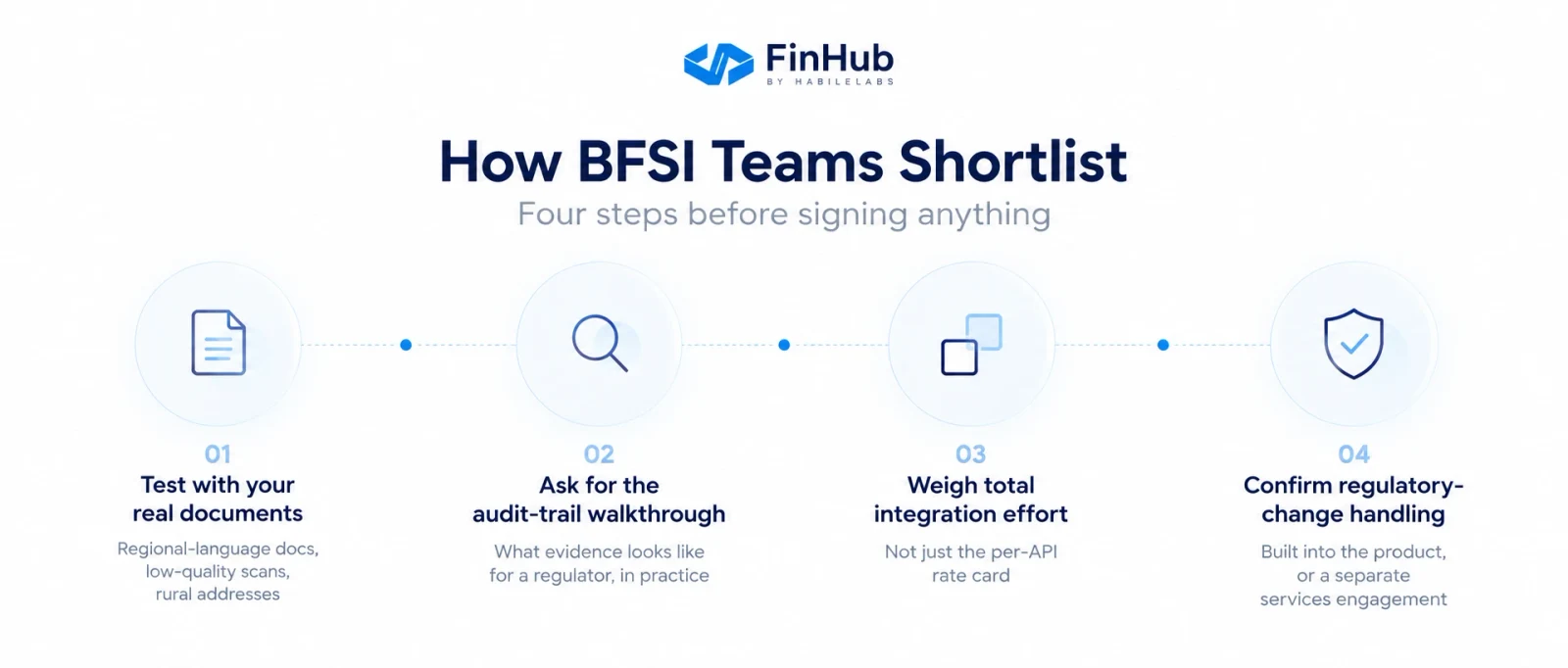
- Test the platform against your own real document types and edge cases (regional-language documents, low-quality scans, rural addresses), not just a vendor's demo environment.
- Ask each vendor to walk through exactly what evidence they can produce for a regulator or internal auditor, and in what format, rather than taking a compliance claim at face value.
- Evaluate total integration and operational effort alongside price, since per-API cost alone doesn't capture engineering time or ongoing vendor management.
- Confirm how the platform handles regulatory changes (DPDP guidance updates, RBI circulars) going forward, and whether that's built into the product or a separate services engagement.
If a single BFSI KYC platform approach to onboarding and compliance infrastructure is relevant to what you're evaluating, the FinHub team is available to talk through specifics. This piece is meant to support that evaluation, not replace it.
Ready to See FinHub in Action?
If vendor sprawl, fragmented audit trails, or a vendor renewal that isn't quite fitting your NBFC's workflows anymore is what brought you here, the easiest next step isn't reading another comparison, it's seeing FinHub against your own documents and edge cases.
Book a demo with FinHub and we'll walk through how a single integration, one Consent Engine, and 100+ KYC and verification APIs fit into your existing onboarding flow, no obligation, no sales pressure, just a working session with your team.