FinHub Compliance Desk
· 9 min read
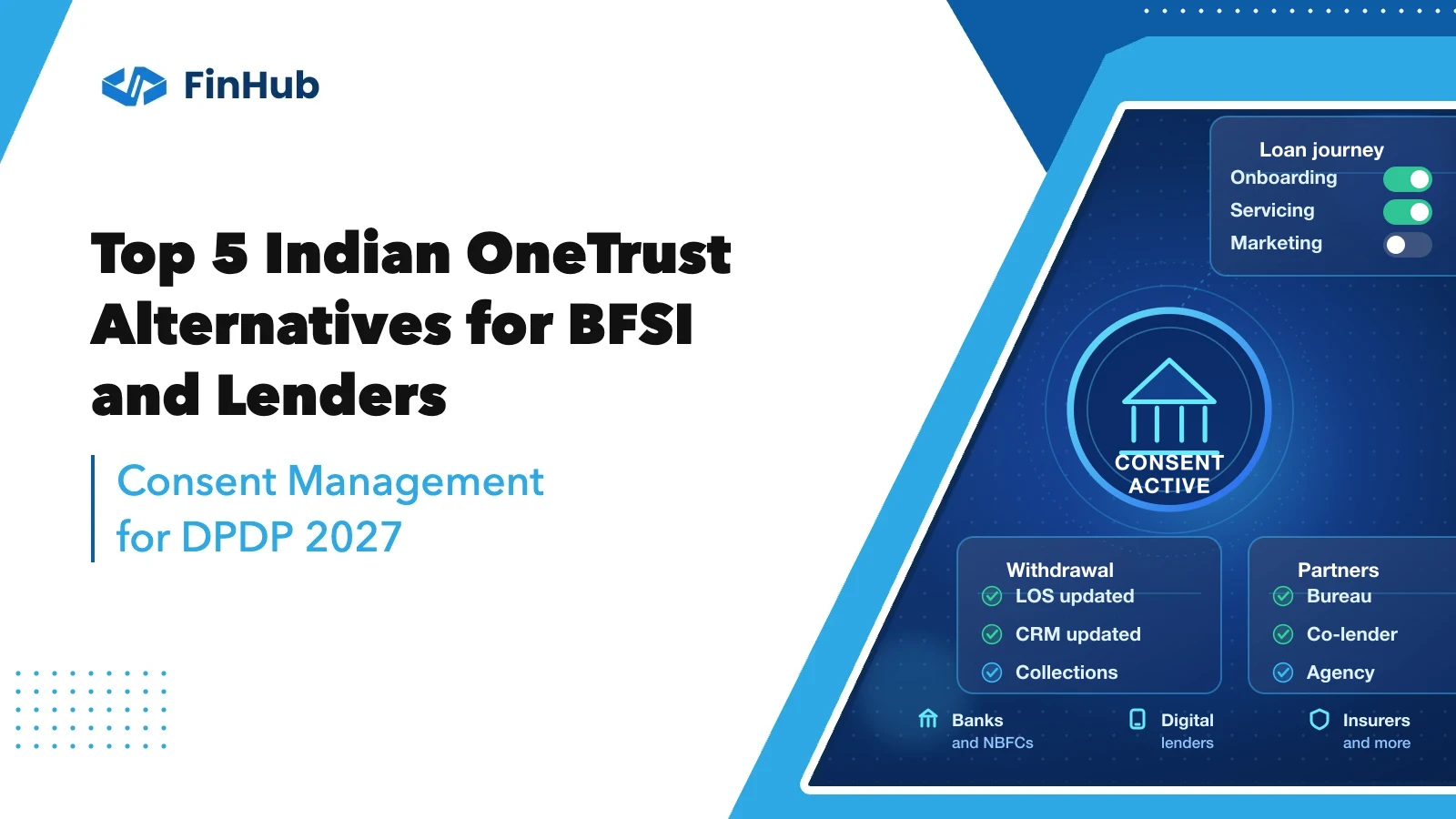
Consent is harder for a lender than for a website. A website has one banner. A lender has an app, a web journey, branches, DSAs, agents and a call centre, and every one of them has to feed the same record. So when you compare consent platforms, the question is less "which one has the nicest notice" and more "which one still works when a borrower withdraws halfway through a loan".
Here are the five Indian platforms banks, NBFCs and digital lenders should compare: ConsentGuard (HabileLabs), Consent.in (Leegality), CoTrust (Digio), Blutic (Neokred) and Privy (IDfy). ConsentGuard is our own product, built for regulated BFSI journeys, so we have put it first and said so. We describe it from our own pages and the others from their public pages. We have not tested any of them, and pricing is not public for most. Treat vendor features as claims to verify, and apply the checklist below to every vendor, including us.
The DPDP Rules' main obligations are widely reported to apply from 13 May 2027 (a few sources say 14 May). Lenders that wait for that date to start a proof of concept risk running out of road.
Why is consent harder for lenders than for a website?
- Many touchpoints: app, web, branch, DSA, agent and call centre must all feed one record.
- Purpose-specific use: underwriting, servicing, collections, cross-sell and bureau reporting are different purposes. Bundled consent is a risk.
- Withdrawal has downstream effects: withdrawing marketing consent is not the same as withdrawing consent for data a live loan depends on. The decision has to reach your LOS, core banking, CRM and collections.
- Third parties: bureaus, co-lenders, LSPs and collection agencies. A withdrawal has to reach processors too.
- Audit pressure: boards and auditors ask for evidence, not policy documents.
- Deployment constraints: some banks need on-premise or private cloud. One vendor guide lists it among bank criteria, so ask every vendor.
Common complaints, and what they mean for BFSI
| Complaint | Evidence | Demo test |
|---|---|---|
| Consent in one click, withdrawal by email | Indian legal commentary lists hard withdrawal as a common mistake. DPDP expects equal ease. | Withdraw in the demo and count the steps. |
| Withdrawal recorded, processing continues | A frequent failure in compliance commentary, for example marketing that still goes out. | Show the withdrawal reaching LOS, CRM and collections. |
| Bundled or vague consent | Commentary says agree-to-all and pre-ticked patterns are legally risky. | Confirm separate purposes and no pre-ticked boxes. |
| Incomplete consent records | One audit found records missing timestamps, purposes or collection method, often from legacy systems. | Export a full consent history for one customer. |
| Slow, heavy setup | G2 lists about three months to implement OneTrust Privacy Automation. | Ask for a pilot plan on one live journey. |
| Consent service slows journeys | Independent analyses show consent scripts can hurt load and interactivity. | Test behaviour at peak load, and what happens if the consent service is down. |
| Renewal and pricing surprises | Reviewers mention renewal increases, though we could not verify specific figures. | Get a written quote with renewal caps. |
The five at a glance
| Platform | Built by | BFSI relevance (per vendor or press) |
|---|---|---|
| ConsentGuard | HabileLabs (FinHub) | Built for banks, NBFCs, housing finance companies, digital lenders and insurers; consent for onboarding, loan origination, servicing, collections and marketing |
| Consent.in | Leegality | Consent across customer and vendor journeys |
| CoTrust | Digio | Bank-focused DPDP guidance; purpose-level consent mapped to records of processing |
| Blutic | Neokred | Partnership for consent in the Unified Lending Interface |
| Privy | IDfy | Identity and verification heritage; consent, rights and governance suite |
1. ConsentGuard by HabileLabs (FinHub)
ConsentGuard is the DPDP consent engine in HabileLabs' FinHub platform, built for regulated BFSI organisations: banks, NBFCs, housing finance companies, digital lenders, insurers and payment companies. It is ours, so weigh our description accordingly.
How it maps to lending journeys
- Onboarding: consent captured before identity verification, eKYC and account opening.
- Loan origination: consent for credit bureau checks, income verification and underwriting.
- Servicing and collections: purpose-specific consent records for each.
- Marketing: separate consent for SMS, email, WhatsApp and voice campaigns.
What it does
- Checks whether consent is active, expired or withdrawn before data is processed.
- Gives the customer a portal to review, renew or withdraw optional purposes, and to raise rights requests or grievances. Purposes you must retain by law stay locked and are labelled.
- Keeps a tamper-evident, hash-chained audit log of timestamps, user actions and purpose details, exportable as CSV or PDF.
- Captures consent across web, mobile, branch, IVR and partner channels, with notices in English and the 22 Eighth Schedule languages.
- Connects through APIs and SDKs to onboarding platforms, CRMs, LOS, document management and customer portals.
ConsentGuard runs as SaaS, and we talk through deployment options for regulated environments during scoping. Ask us, as you should ask everyone, about security attestations and pricing. See pricing or book a demo.
2. Consent.in by Leegality
- Consent across channels as DPDP-style artefacts, a two-click notice and 22 languages.
- A privacy rights centre, automated breach notices and a consent interface for third-party sharing.
Ask: how consent states reach your LOS and core banking, and how it performs at peak load.
3. CoTrust by Digio
- Timestamped, purpose-linked, tamper-evident records with version history.
- Separate consent per purpose mapped to records of processing, with withdrawal propagation to affected systems.
- Immutable audit logs, SDKs and APIs, and age-gating and parental consent flows.
Ask: which security certifications it holds (we did not find them confirmed in the sources we reviewed) and how its workflows connect to core systems.
4. Blutic by Neokred
- A consent dashboard with time-based consent and revocation.
- A partnership with Quickwork for consent in the Unified Lending Interface.
- DPDP-ready cookie consent verified for Google Tag Manager, plus 2026 compliance and discovery modules.
Ask: how the newer governance modules perform in production, and whether it has lender references of your size.
5. Privy by IDfy
- Multilingual notices, revocation and versioning, with automated rights requests.
- Tamper-proof consent storage, automated records of processing and a data governance layer called Data Compass.
Ask: module-by-module pricing, and how it integrates with your KYC and onboarding stack.
Also worth a look: truConsent
A DPDPA-native platform with two discovery tools, truScanner for code and APIs and truFinder for databases and logs. Public sources did not confirm bank-specific features such as core banking integration or branch and DSA coverage, so ask for proof.
A vendor checklist for your RFP
- Capture across app, web, branch, DSA, call centre and partners, shown live.
- Separate purposes for underwriting, servicing, collections, marketing and bureau reporting.
- Withdrawal flowing to LOS, core banking, CRM and collections.
- Third-party consent shared with and revoked from bureaus, co-lenders, LSPs and agencies.
- A full consent history export for one customer, with timestamps and versions.
- SaaS, private cloud or on-premise, plus data residency.
- Latency, availability and failure behaviour.
- Security attestations in writing.
- Notices tested in your borrowers' languages.
- How the vendor tracks DPDP and RBI changes.
- Total cost, including renewal terms.
Talk to HabileLabs
Running a bank, NBFC, housing finance company or digital lender? Book a ConsentGuard demo or try the FinHub APIs free. Relevant pages: NBFCs, banks, digital lenders, the digital lending use case, the DPDP compliance use case and the DPDP guide. For the general comparison, see our Top 5 OneTrust alternatives from India. For the wider checklist, read 2027 must-have features in a consent management platform.